Customer Login
If you are already registered, please log in.
Articles
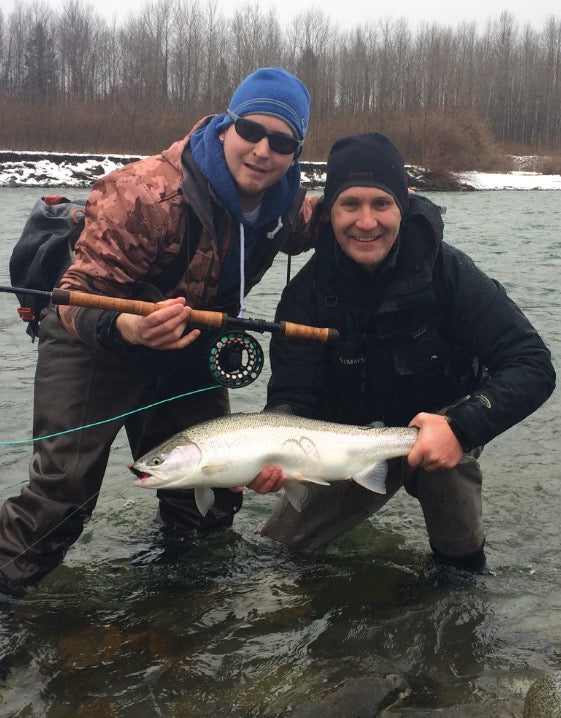

This blog post focuses on the pursuit of Coho Salmon in freshwater with gear fishing tackle. Coho in freshwater can be funny creatures. When they’re feeding in the open ocean it usually seems like one could throw anything at them and they’ll bite. The same can be said in freshwater some days, but the majority of days you will really have to work and throw different things at them to determine what the preference of the day is. Let’s look first at our rod and reel selection.
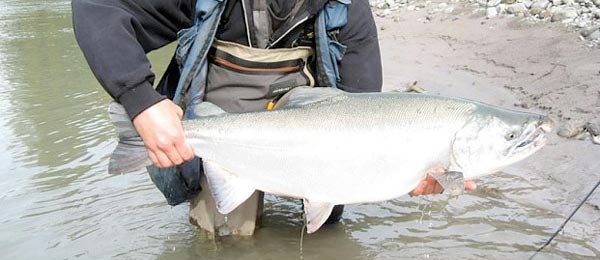
Our first combo is the sought-after centrepin combo. Rods are typically between 9′-11’3″ and will differ from a baitcasting rod in the handle design.
A shorter rear grip and longer fore grip are required for our centrepin rods as the reel sits lower on the handle. Centrepin reels are quite simple machines, but at the same time are very complex. They are simple in the fact there’s not really much to the reel component-wise compared to either a spinning reel or a baitcasting reel.
Open a centrepin and there’s not too much to look at. Open a baitcasting reel and hope no springs or screws come flying out at you. What can make centrepin reels complex is the very precise machining and manufacturing required to make a smooth-casting (no wobble) fishing reel.
For us at Sea-Run, our top choices of higher end centrepins are the John Milner Kingfisher reels or the Islander Centrepin Reels. For the less costly option, the Okuma Centrepins have been awesome reels without a crazy price tag.

A baitcasting or levelwind type setup would have rod lengths similar to the centrepin rod choices. We will say that for Coho fishing, using the low profile baitcasters or a smaller round baitcasters can be a more comfortable set up for all day fishing, and these higher-numbered bearing reels are smoother and can aid us in casting some of the lighter gear that Coho fishing can sometimes require. These reels typically hold 160-200 yards of monofilament fishing line depending on whether you use 15lb or 20lb line.
Lastly, a freshwater Coho angler's best friend can be a nice light spinning rod from 8’6″-9’6″ with a spinning reel to match that is capable of holding at least 100 yards of mono line. As a general rule, we do like to use mono as our mainline for Coho fishing instead of braid for the stealth factor. This is just a suggestion and you may have a different opinion, and that’s great! Whatever a person has confidence in using should be used!
The spinning setup is under-appreciated in the world of freshwater Coho fishing. This setup does not do as well float fishing as the previous two set ups mentioned because the line comes off the reel spool in loose coils instead of directly off the reel spool as in the baitcasting and centrepin reels. Casting the lighter weighted lures is so much easier and more effective with a spinning reel.
So why would we use one set up over another? Well, centrepins do allow for a better presentation when float fishing and provide the angler more control of their drift. These reels are a fun way to fight a fish and let’s face it, you’re just pretty darn cool if you’re using one!!! A disadvantage on the Coho playing field when using a centrepin can be the inability to cast a very light weight, so casting a spoon or spinner can be difficult.
A baitcaster is the most common and most versatile setup going. We can float fish with these reels and an angler (with practice) can become proficient in casting lighter weights. Also, the reel has a drag system on it unlike the centrepin, so if the big nasty chum salmon latches on to your gear, he can be tamed more easily.
Now that everyone’s armed with three different fishing rod and fishing reel combos, what are we putting on the end of them? Let’s first take a look at a float set up. Floats come in all sorts of shapes and sizes and it really boils down to personal preference.
These days the Cleardirft Floats in 20, 25 and 30 gram sizes, DNE Foam Floats in the same sizes, and Drennan Floats are the most popular on the rivers. Float size should be determined by water conditions. For low and clear water you will want to downsize the float and higher water with more flow or less visibility will need the size increase.
We can either use split shot pencil lead or egg sinkers for our weight. The amount of weight should be such that the float is “loaded properly”. We basically want the coloured part of the float above the water throughout the whole drift.

Too little weight and the float gets pushed around and bite detection decreases, too heavy a weight and the float does not ride correctly and will keep bobbing under the water making bite detection difficult. Split shot weights do generally allow for a nicer presentation and more natural drift and in slower water can land more softly, making for a stealthier approach.

Pencil lead and egg sinkers can get an angler's gear down faster so it can be an advantage in faster currents or deeper pools. Like the floats, weight selection can boil down to personal preference.

The use of fluorocarbon as our leader is a huge advantage as Coho can be leader shy at times for gear fishing. Using the right fluorocarbon is critical, and Seaguar Blue Label in 10lb-15lb is pretty much unbeatable. Our leader length should not exceed much more than 24”.
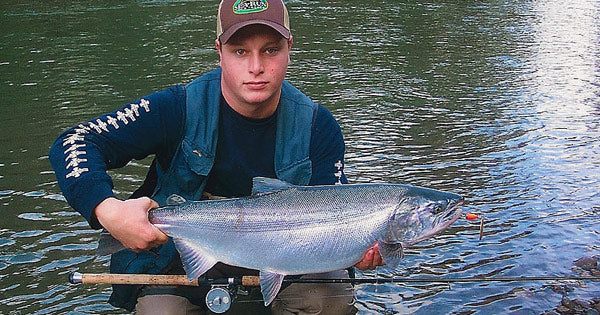
For our float fishing we can choose to use natural salmon eggs (check regulations to make sure bait usage is allowed), shrimp or prawn meat, TroutBeads Standard, TroutBeads Mottled, TroutBeads Blood Dot, Spirit River Fusion UV2 Beads, Cleardrift Soft Beads, BNR Soft Beads, Gibbs Colorado Spinner Blades or wool combinations. All of these are most effective when fished just off the bottom and not dragging on the bottom! Lures are deadly effective for Coho especially in some of the slower waters that they so love to inhabit.

Spinners are a top producer for Coho, both the Prime Lures Clean Up Spinners and the Blue Fox Vibrax will be on the fall Coho dinner menu. Available in all sorts of colour schemes, one cannot have enough different choices to throw out there as they all work, but some days one can be better than another and some river systems fish will like one colour over another. Just be ready with options to throw out there!

Don’t be afraid to throw out fairly good-sized spinners in some conditions. The number four and five sized spinners can out-produce the smaller ones, and don’t be surprised by the success one can have by adding a small pink hootchie behind a spinner. Coho can go crazy for that lure! We do recommend using a short leader when throwing spinners to prevent line twisting. Also, some weight can be added to a spinner without having an effect on the action of the lure.

Spoons, on the other hand, can be fished straight to the main line and we should try to avoid adding any weight to a spoon as it can have a negative effect on the lure's action. Prime Lures Glory Spoon, Art Fishing River Dolphin, Art Fishing Bite Spoon, Gibbs Croc, Gibbs Koho, and Gibbs Kit-A-Mat Spoons are all popular Coho spoons, again, available in a variety of colours. Twitching jigs are also a very effective method to use when targeting Coho. Mostly we fish a marabou jig or rabbit jig below a float but Coho love to chase things so why not make them chase our jigs?

When twitching a jig we want to use a good sized jig head as this will be our weight. 3/8oz or 1/4oz is the most desirable. We want these jigs to swim, so a long-tailed jig made of rabbit fur or a plastic curly tailed grub is best. These grubs just come alive in the water! We cast our jig out in to the pool and retrieve if back as if it were a spoon or spinner but twitch the rod tip up and down, not a snagging motion. Hang on tight as fish will slam this lure!!!! Watch our video on how to properly twitch a jig for Coho.
The last little trick in the tackle box for Coho in the slower moving water is a Worden's Flatfish Lure in an F-6 or F-7 size, cast out with a bit of weight and very slowly retrieved back to you. These lures wiggle back and forth and Coho just can’t seem to say no to them.

Check out our Fly Fishing for Coho in Freshwater 101 blog post!
Post your questions in the comments section below or feel free to contact us by email info@sea-run.com, by phone at 604-931-5044 or stop by
Sea-Run Fly & Tackle at #110 1140 Austin Avenue in Coquitlam BC.
Good luck on the water.
Follow and Like Us
Like us on Facebook: https://www.facebook.com/searun
Follow us on Instagram: http://instagram.com/searunflyandtackle
Subscribe on YouTube: https://www.youtube.com/@searunflytackle
2 comments
Customer Login
If you are already registered, please log in.


Interested in The Product
Good afternoon.
Just wondering if there will be an opening for coho on the lower Fraser river?
Thanks Mike